
In the context of the rapidly evolving digital economy, knowledge has moved beyond being merely a supporting resource to becoming a strategic asset that determines an enterprise’s competitive advantage. Knowledge no longer exists only in data or documents; it is embedded in processes, experience, and the way organizations operate on a daily basis.
However, an important reality is that many businesses possess vast amounts of knowledge but are not utilizing it effectively, resulting in wasted intangible resources and declining operational efficiency. These “gaps” are often not immediately visible, yet they silently accumulate and create significant costs over time.
Below are three common challenges that directly impact organizational performance:
1. Bottlenecks in Information Search and Retrieval
According to a report by the McKinsey Global Institute, knowledge workers spend an average of approximately 20% of their workweek searching for information or contacting colleagues to retrieve data needed for their tasks.
This reflects a fundamental issue: knowledge exists, but it is not easily accessible.
In many organizations, information is scattered across various systems such as emails, internal files, storage platforms, or even individual employees’ personal experience. The lack of an effective organization and retrieval mechanism makes searching time-consuming and highly dependent on chance.
The consequences go beyond wasted time and include:
Reduced employee productivity
Increased errors caused by using outdated information
Inconsistency in workflows, especially in customer-facing departments
2. Knowledge Disruption During Employee Turnover
“Knowledge leakage” is one of the most common yet underestimated risks in business management. When key employees leave or change roles, the knowledge accumulated over time — including problem-solving experience, system understanding, and customer insights — may not be fully transferred.
According to HR studies, the cost of recruiting and training a new employee to reach equivalent productivity typically ranges from 6 to 9 months of that position’s salary. However, the actual cost is often much higher when factoring in:
Workflow disruptions
Temporary dependence on other employees
Potential decline in service quality
The core issue lies in the fact that knowledge has not been standardized and systematically stored, causing businesses to rely heavily on individuals rather than organizational capability.
3. Training Effectiveness and Skill Gaps
Internal training is one of the areas where businesses invest heavily, yet the outcomes are not always proportional to the investment. Generic, one-size-fits-all training models often result in content that does not align with the actual needs of each role.
Practical data shows that around 40% of training budgets are allocated to content that does not closely match the required competencies, leading to:
Low knowledge retention and application rates
Difficulty measuring training effectiveness
A gap between learned knowledge and real-world tasks
In addition, the lack of continuous progress tracking and competency assessment tools makes it difficult for businesses to build structured and sustainable employee development roadmaps.
These challenges highlight a clear reality: if knowledge is not managed and utilized effectively, it becomes a wasted resource instead of a driver of organizational value.
As businesses continue to scale and face increasing pressure to improve efficiency, building a structured knowledge management system is no longer optional — it has become essential. Companies need a platform capable of:
Centralizing and standardizing internal knowledge
Supporting fast and accurate information retrieval
Directly connecting with training and competency development activities
Leveraging technology to improve information utilization efficiency
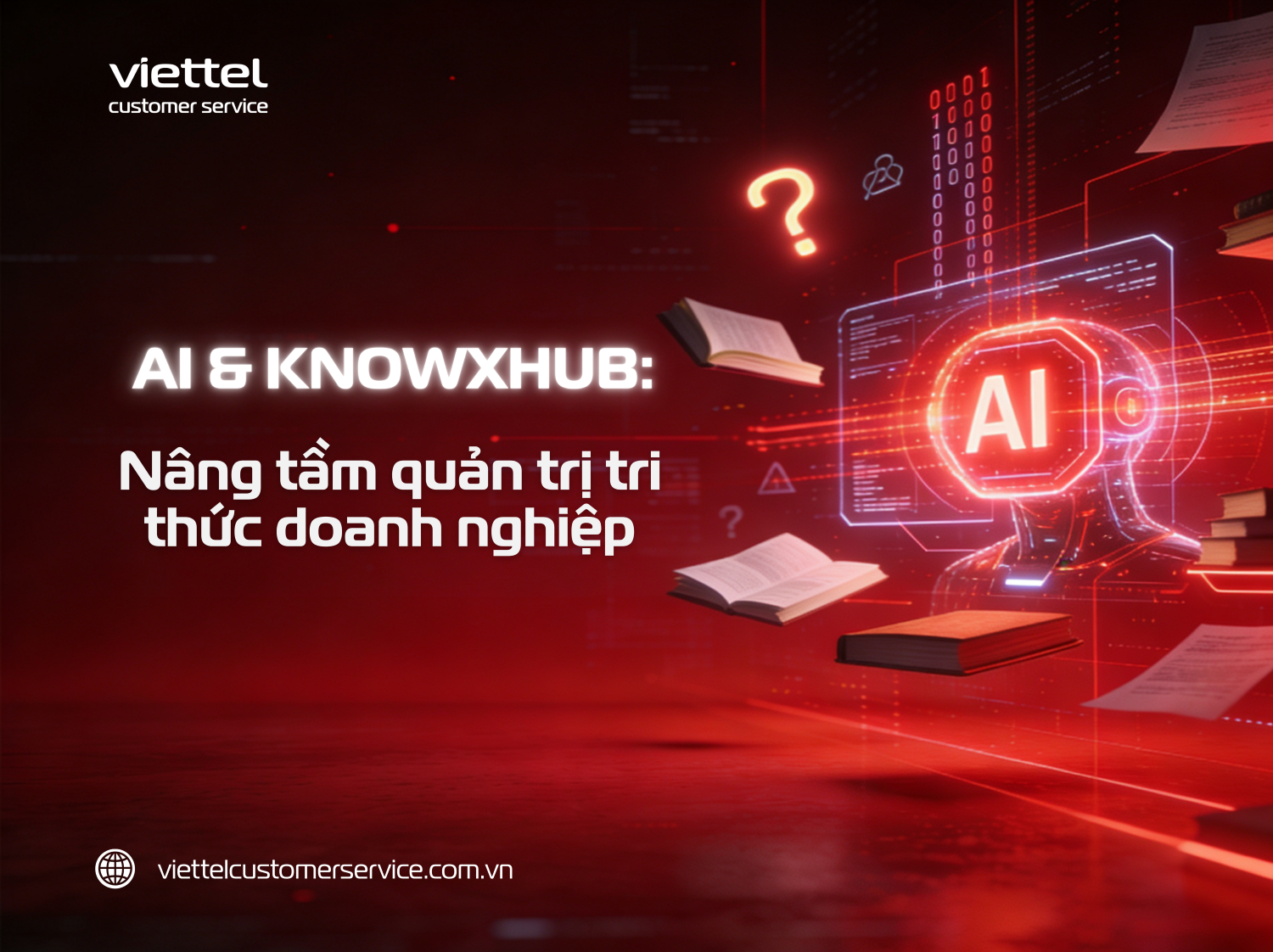
Based on operational realities and increasingly evident market demands, the KnowXHub solution developed by VCX was created to comprehensively address these challenges. The platform integrates knowledge management and learning management, combined with AI technology, enabling businesses not only to store information but also to transform knowledge into a tool that supports operations and enhances organizational performance.
Investing in a system like KnowXHub is not simply an investment in technology; it is a strategic move to preserve intellectual assets, develop workforce capabilities, and build a sustainable foundation for long-term growth.




-RxlKjOrx.png)
![[CafeF] AI ngày càng mạnh, vì sao trải nghiệm khách hàng vẫn chưa liền mạch?](/cms/api/v1/public/files/view/2aoboqxgjee66fgq53fz4heneplcjvhajrwymlao-ozJIyknq.jpg)
-hpO4jnDx.png)