
Virtual assistants have become one of the key technologies driving enterprise digital transformation. From chatbots, callbots, and voicebots to AI Assistants, AI Agents, and Virtual AI Agents, today's AI-powered assistants can do far more than answer questions—they can use tools, access enterprise data, and automate complex business tasks.
Despite their growing adoption, these technologies are often misunderstood or assumed to be different names for the same concept.
In reality, they represent successive stages in the evolution of virtual assistants. Each generation has been developed to overcome the limitations of its predecessor while expanding capabilities in communication, language understanding, and task execution. Whereas early virtual assistants could only respond to predefined scripts, modern AI systems can understand context, plan workflows, access enterprise knowledge, and coordinate multiple tools to accomplish business objectives much like a human employee.
Understanding this evolution helps organizations choose the right AI solution while providing a clearer view of the future of enterprise AI, Generative AI, and intelligent automation.
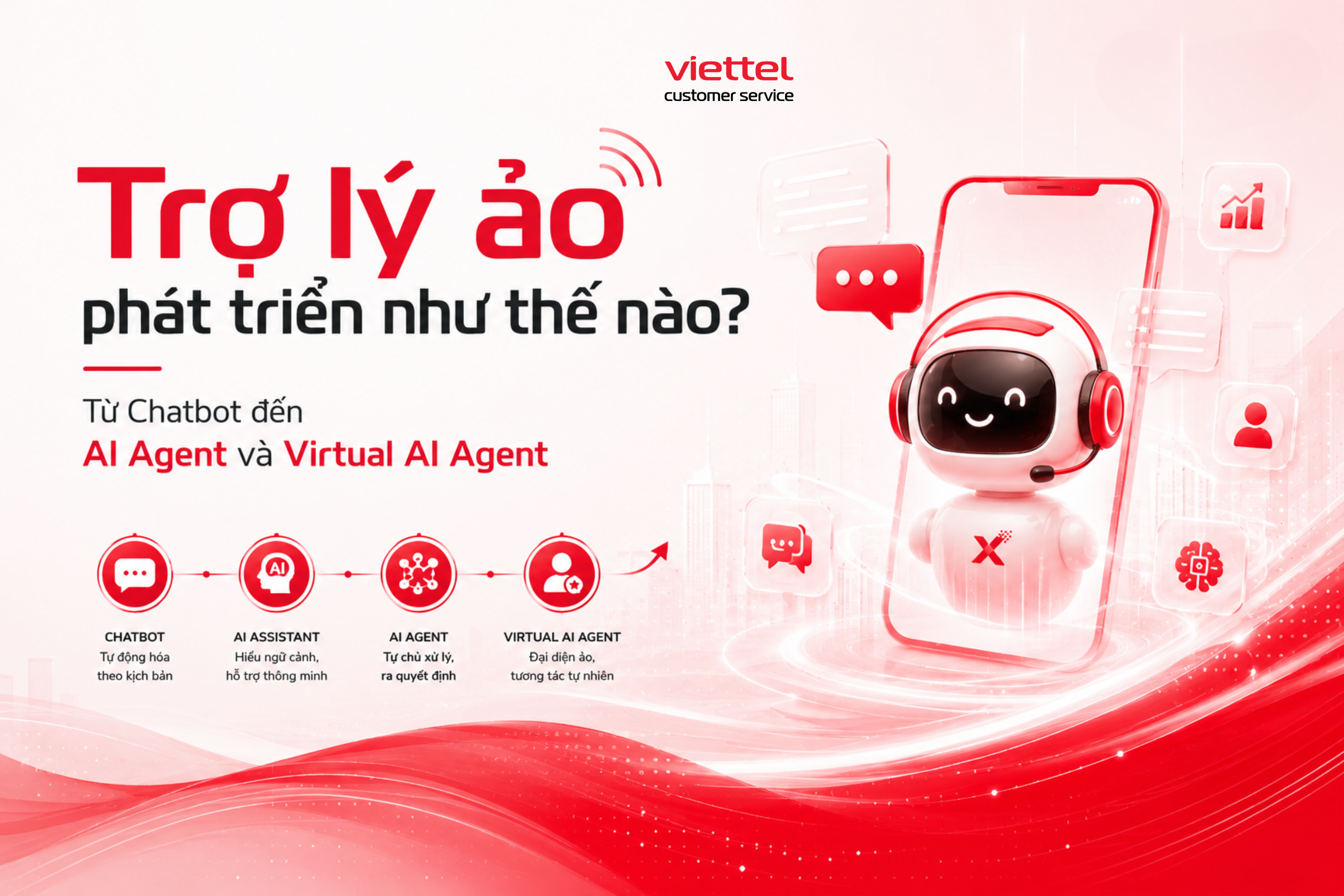
The Evolution of Virtual Assistants
The development of virtual assistants can be divided into ten major stages:
Automation
Rule-based Chatbots
NLP Chatbots
Voicebots and Callbots
LLM Chatbots
RAG Chatbots
AI Assistants
AI Agents
Virtual AI Agents
Multi-Agent Systems and Autonomous AI
Each stage represents a significant leap in AI capability. While early systems relied entirely on predefined rules, modern virtual assistants can understand natural language, access enterprise data, utilize external tools, and autonomously plan and execute tasks.
Stage 1: Automation — The Foundation of Virtual Assistants
Long before artificial intelligence became mainstream, businesses relied on automation systems to handle repetitive tasks.
These systems operated using simple "if-this-then-that" logic—for example, sending confirmation emails after customer registration, updating order statuses, or synchronizing data between software platforms.
Automation significantly reduced manual work and improved efficiency but lacked any ability to understand language or communicate with users. Nevertheless, it laid the foundation for future generations of virtual assistants.
Stage 2: Rule-based Chatbots — Scripted Conversations
As online customer service became increasingly important, rule-based chatbots emerged as a popular solution for websites and messaging platforms.
These chatbots relied entirely on predefined conversation flows. Users needed to click specific options or enter expected keywords for the chatbot to provide an appropriate response. Any question outside the predefined script typically resulted in failure.
Although limited, rule-based chatbots marked the beginning of automated customer interactions.
Stage 3: NLP Chatbots — Understanding Natural Language
The next generation introduced Natural Language Processing (NLP), enabling chatbots to recognize user intent instead of simply matching keywords.
For example, questions such as "Can I get a quotation?", "How much does it cost?", and "What's the price?" can all be interpreted as the same request.
This significantly reduced the number of conversation flows businesses needed to build while creating more natural interactions.
However, NLP chatbots still depended heavily on pre-trained intents and entities, limiting their ability to handle complex or unfamiliar scenarios.
Stage 4: Voicebots and Callbots — AI That Can Listen and Speak
Advances in speech recognition enabled virtual assistants to move beyond text into voice interactions.
Voicebots and Callbots can answer phone calls, convert speech into text, analyze customer requests, generate responses, and communicate back using synthesized speech.
This enables businesses to automate contact centers, appointment reminders, order confirmations, customer service, and 24/7 support.
Technically, Callbots are not an entirely new technology—they are chatbots operating over voice channels. Today, they form the foundation of many AI-powered contact centers.
Stage 5: LLM Chatbots — The Generative AI Breakthrough
The emergence of Large Language Models (LLMs) fundamentally transformed virtual assistants.
As the foundation of Generative AI, LLMs allow AI to understand natural language, reason, and generate human-like responses.
Instead of relying on thousands of predefined conversation flows, LLM-powered chatbots can answer a broad range of questions using natural language.
Platforms such as ChatGPT have demonstrated that AI can assist with writing, software development, translation, data analysis, and many other knowledge-intensive tasks.
This represents one of the most significant milestones in the evolution of AI assistants.
Stage 6: RAG Chatbots — Combining AI with Enterprise Knowledge
Despite their impressive capabilities, LLMs do not inherently know an organization's internal data.
This limitation led to the development of Retrieval-Augmented Generation (RAG).
Instead of relying solely on pre-trained knowledge, RAG enables AI to retrieve relevant information from internal documents, corporate websites, CRM systems, ERP platforms, and enterprise databases before generating responses.
As a result, AI assistants can provide accurate answers based on continuously updated business information without requiring model retraining.
Stage 7: AI Assistants — AI That Performs Tasks
At this stage, AI moves beyond answering questions to actively completing work.
For example, when asked to schedule a meeting, an AI Assistant can check calendars, create meeting invitations, send emails, and synchronize events across scheduling platforms.
Through integrations with CRM systems, ERP software, email, calendars, and business applications, AI Assistants bridge conversational AI with enterprise workflow automation.
Stage 8: AI Agents — AI That Can Plan
AI Agents represent the next major evolution of virtual assistants.
Unlike AI Assistants, which typically execute individual requests, AI Agents can receive a high-level objective, analyze the task, break it into multiple steps, select appropriate tools, and complete complex workflows with minimal user guidance.
Their ability to plan, coordinate, and evaluate their own work has made AI Agents one of the fastest-growing trends in enterprise AI.
They are increasingly capable of automating parts of sales, customer service, marketing, and business operations previously performed by human employees.
Stage 9: Virtual AI Agents — AI Employees
A Virtual AI Agent is not a new technology but rather an AI Agent assigned to a specific business role.
A Virtual Sales Agent can recommend products and engage customers.
A Virtual HR Agent can assist with recruitment and answer HR policy questions.
A Virtual Customer Service Agent can support customers across websites, mobile applications, and contact centers.
Many organizations now view Virtual AI Agents as digital employees capable of working across multiple communication channels while integrating seamlessly with enterprise systems.
Stage 10: Multi-Agent Systems and Autonomous AI — The Next Frontier
As AI continues to advance, organizations are increasingly deploying multiple AI Agents instead of relying on a single assistant.
Each agent specializes in a particular function—such as sales, research, customer service, data analysis, or marketing—and collaborates with others to achieve shared business objectives.
The next stage is Autonomous AI, where AI systems continuously monitor operations, evaluate performance, optimize workflows, and make decisions with minimal human intervention.
This is widely regarded as the future direction of enterprise virtual assistants.
From simple automation systems to chatbots, callbots, AI Assistants, AI Agents, and Virtual AI Agents, virtual assistants have evolved into intelligent business tools capable of transforming enterprise operations.
Each generation has addressed the limitations of the previous one, enabling AI not only to understand language but also to use tools, access enterprise knowledge, and perform increasingly sophisticated tasks much like human employees.
As Generative AI, Multi-Agent systems, and Autonomous AI continue to mature, virtual assistants will play an even more central role in enterprise automation—improving productivity, optimizing operations, and delivering superior customer experiences.
Viettel Customer Service is a subsidiary of the Viettel Group, operating in the technology and customer service sector. The company provides a comprehensive ecosystem including services (Contact Center Outsourcing, BPO, Upsale, Customer Experience, Loyalty, Document Processing and Digitization, Warranty & Repair Services) and technology solutions (OmniX, CXBot, KnowX Hub, AI-DMS, vCOC, InsightCI, WorkforceX).
Contact Viettel Customer Service today for solutions tailored to your business!
Contact Information:
Hotline: 1800 9397 / Email: dvkh@viettel.com.vn
Website Viettel Customer Service / Facebook Viettel Customer Service / Zalo Viettel Customer Service
Address: 23rd floor, Vinacomin Building, 3rd Duong Dinh Nghe Street, Yen Hoa Ward, Hanoi.








![[VnEconomy] Unifying Customer Service Channels: A Strategic Step in the Age of AI](/cms/api/v1/public/files/view/omnix-bao-MjC3Jlm9.png)


