In many businesses, a Knowledge Management System (KMS) is implemented to centralize documents and make information easier for employees to access. However, as organizations grow, business processes evolve rapidly, and customer service expectations rise, a system that primarily functions as a “document repository” may no longer be enough.
At this stage, knowledge needs to do more than simply be stored. It must be easy to find, properly governed, continuously updated, and transformed into practical capabilities that employees can apply in their daily work. If your business is experiencing the following signs, it may be time to consider replacing a traditional KMS with a more comprehensive knowledge management platform.
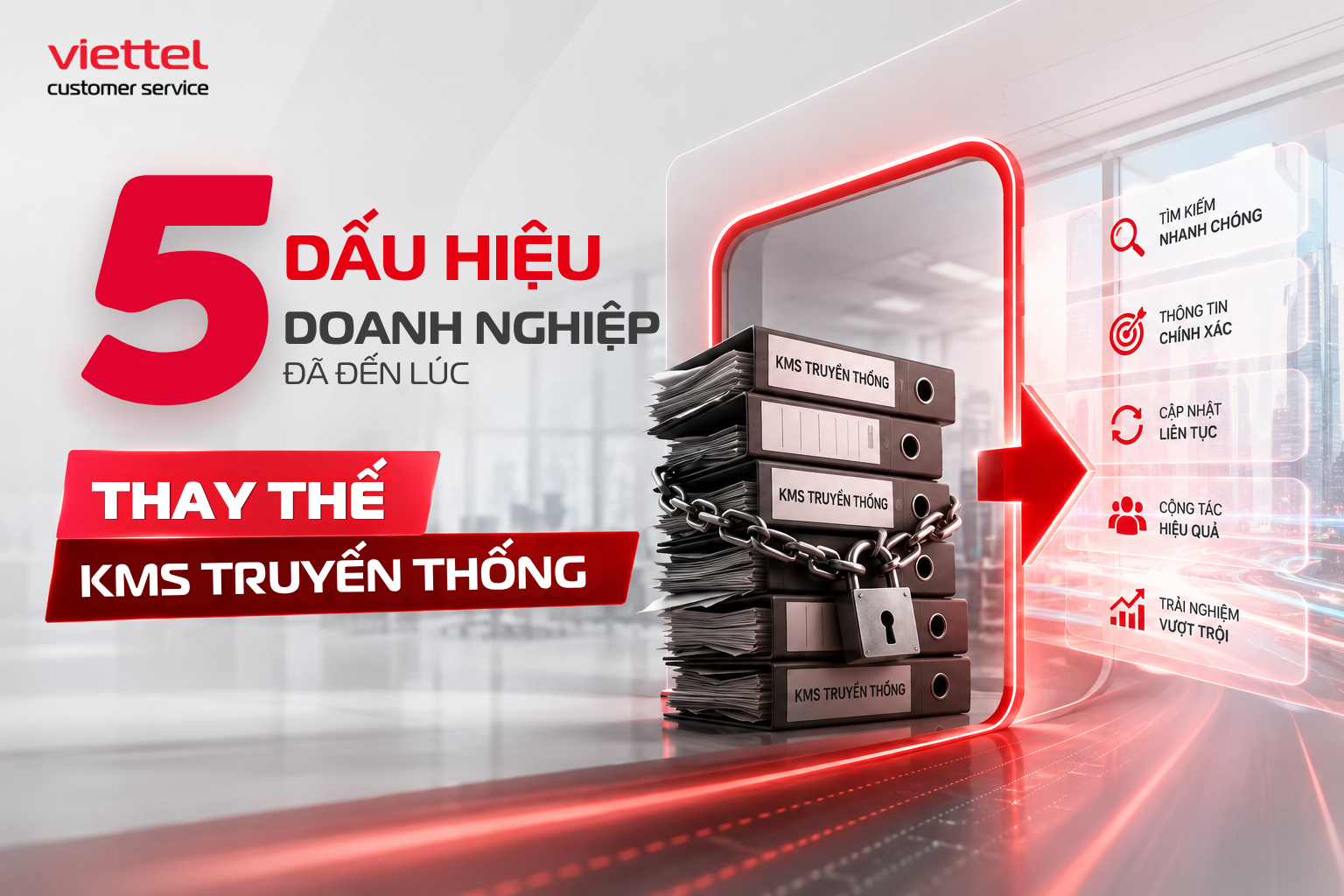
1. Employees Spend Too Much Time Finding the Right Information
One of the most obvious signs is that the business has a large volume of documents, yet employees still frequently need to ask colleagues, search through multiple folders, or try different keywords before finding the information they need. This is a common challenge when information is fragmented and difficult to retrieve.
Traditional KMS platforms often rely heavily on folder structures and keyword-based search. In practice, however, employees need search capabilities that can understand different ways of phrasing a question as well as the user’s intent. Fuzzy search can account for variations in spelling, punctuation, and wording, while AI can understand context, summarize information, and recommend relevant content.
When the time spent searching for information begins to directly affect operational efficiency and customer service speed, businesses need more than a “place to store documents.” They need a system that delivers the right knowledge to the right person at the right time.
2. Knowledge Depends Too Heavily on Key Employees
When an experienced employee leaves, the business may also lose valuable operational knowledge accumulated over many years. This is a clear sign that organizational knowledge still resides more in people than in the system.
A next-generation KMS should enable businesses to establish a structured knowledge lifecycle, from creation and management to updating, sharing, and utilization. This allows organizational knowledge to be retained and transferred to new employees instead of disappearing when experienced staff leave.
3. You Cannot Control Which Version of a Document Employees Are Using
For frequently changing information such as policies, procedures, or customer service guidelines, using an outdated document can result in incorrect advice or inconsistent execution.
A KMS, therefore, should go beyond simply uploading and storing documents. Businesses need to manage knowledge updates, access permissions, and the content employees are actively using. This helps ensure that employees follow consistent processes, reduce errors, and improve operational consistency.
This is particularly important in Contact Centers, where employees are expected to respond to customers within a short period of time. Fast and accurate access to information becomes a critical operational requirement.
4. Knowledge Management and Training Operate Separately
Another common sign is that the business uses a KMS to store documents but relies on a separate system for employee training, testing, and assessment. When these two activities operate independently, it becomes difficult to determine whether employees have read the latest materials, how well they understand the knowledge, and whether they are capable of applying it effectively in their work.
A modern platform should connect knowledge management with learning management, allowing businesses to organize training courses, manage learning materials and assessments, conduct online exams, and track employees’ learning progress and results.
Knowledge management then no longer ends with “the document has been uploaded to the system.” Instead, knowledge can continue through a structured process of learning, assessment, and employee capability development.
5. Your Business Has Data but Cannot Measure Knowledge Utilization
How many employees are actively using the knowledge base? Which content is searched most frequently? Have employees completed their training programs? How well did they perform in assessments?
If your current KMS cannot answer these questions, your knowledge management strategy is still missing a critical component: measurement.
The ability to track learning progress, assessment results, and training effectiveness allows businesses to understand how knowledge is actually being absorbed and applied, rather than simply measuring how many documents have been stored.
6. KnowX Hub – Turning Knowledge into Operational Capability
When a business experiences several of these signs at the same time, the solution is no longer simply to add more documents to an outdated KMS. What needs to change is the way the organization creates, governs, searches, learns, evaluates, and applies knowledge within a unified ecosystem.
Developed by VCX, KnowX Hub is an integrated Knowledge Management and Learning Management platform that brings together document creation and management, intelligent search, online learning, and assessments within a single system. The platform also incorporates AI Search and AI Assistant to help employees find answers and access relevant information faster based on context.
For Contact Center environments in particular, AI Assistant can retrieve and present relevant information exactly when employees need it, reducing the time agents spend searching for answers and allowing them to focus more on serving customers.
Replacing a traditional KMS, therefore, is not simply about switching software. It represents a shift from “storing knowledge” to “operating with knowledge”—turning organizational knowledge into real customer service capabilities and a foundation for continuous workforce development.
Viettel Customer Service is a subsidiary of the Viettel Group, operating in the technology and customer service sector. The company provides a comprehensive ecosystem including services (Contact Center Outsourcing, BPO, Upsale, Customer Experience, Loyalty, Document Processing and Digitization, Warranty & Repair Services) and technology solutions (OmniX, CXBot, KnowX Hub, AI-DMS, vCOC, InsightCI, WorkforceX).Contact Viettel Customer Service today for solutions tailored to your business!
Contact Information:
Hotline: 1800 9397 / Email: dvkh@viettel.com.vn
Website Viettel Customer Service / Facebook Viettel Customer Service / Zalo Viettel Customer Service
Address: 23rd floor, Vinacomin Building, 3rd Duong Dinh Nghe Street, Yen Hoa Ward, Hanoi.